
Products
Escalators and travelators
Escalators with steps, and travelators, which are moving walks without steps. They run around the clock in all weather, with an energy-saving mode that follows passenger flow. For shopping and leisure centres, airports and stations.
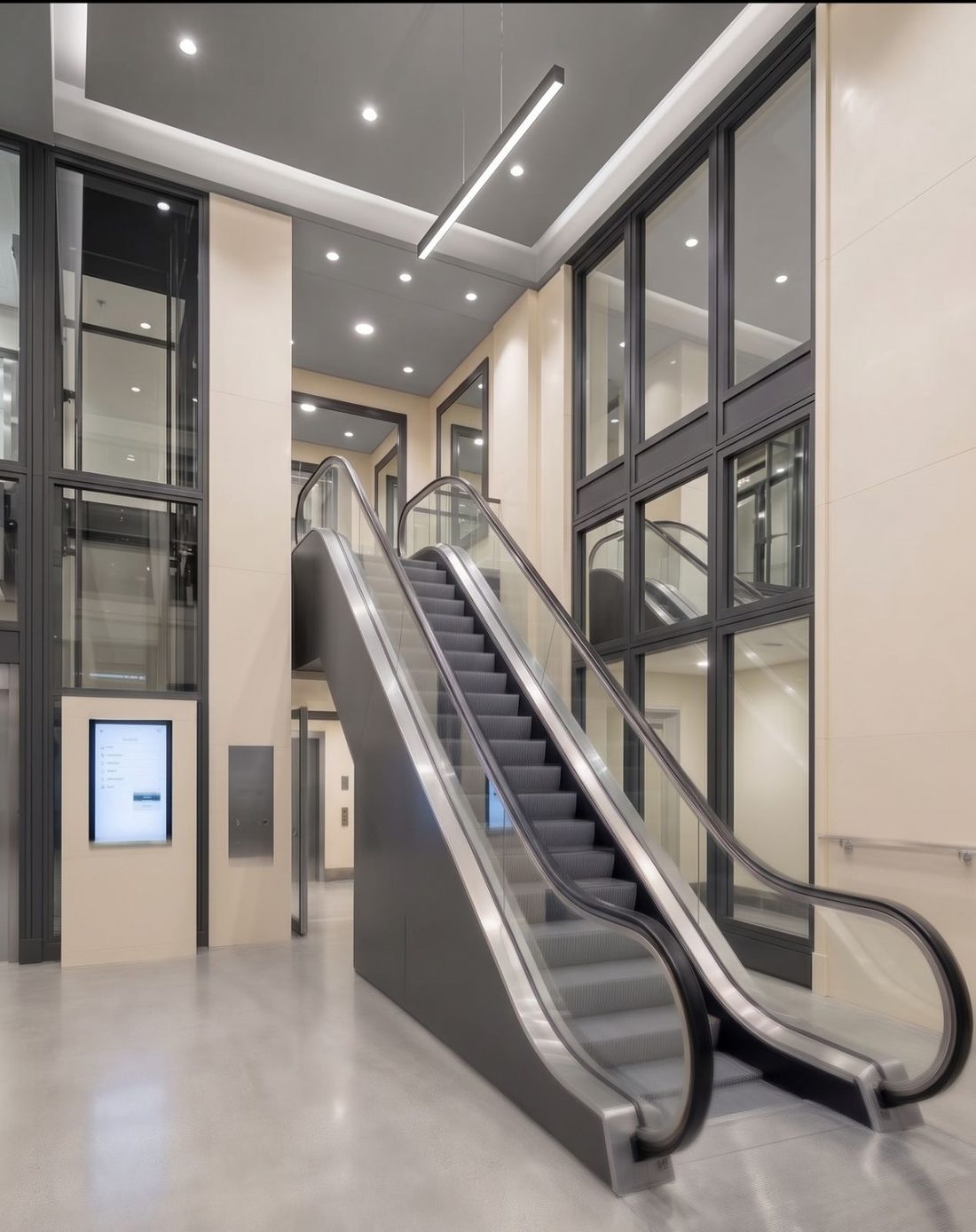
Escalator and travelator
An escalator carries people between floors on steps, at an inclination of 30 or 35 degrees. A travelator is a moving walk: it has no steps and is almost flat, so you can ride it with a trolley or a suitcase.
In both cases we offer the full package from one supplier, which means one contact for the whole project instead of separate suppliers for each system.
| Parameter | Escalator | Travelator |
|---|---|---|
| Power supply | 380 V, 50 Hz | 380 V, 50 Hz |
| Speed | 0.5–0.75 m/s | 0.45–0.75 m/s |
| Inclination | 30° or 35° | 0°-12° |
| Lifting height | 1500–20,000 mm | Per site |
| Motor power | 5.5–15 kW | 4.3–11 kW |
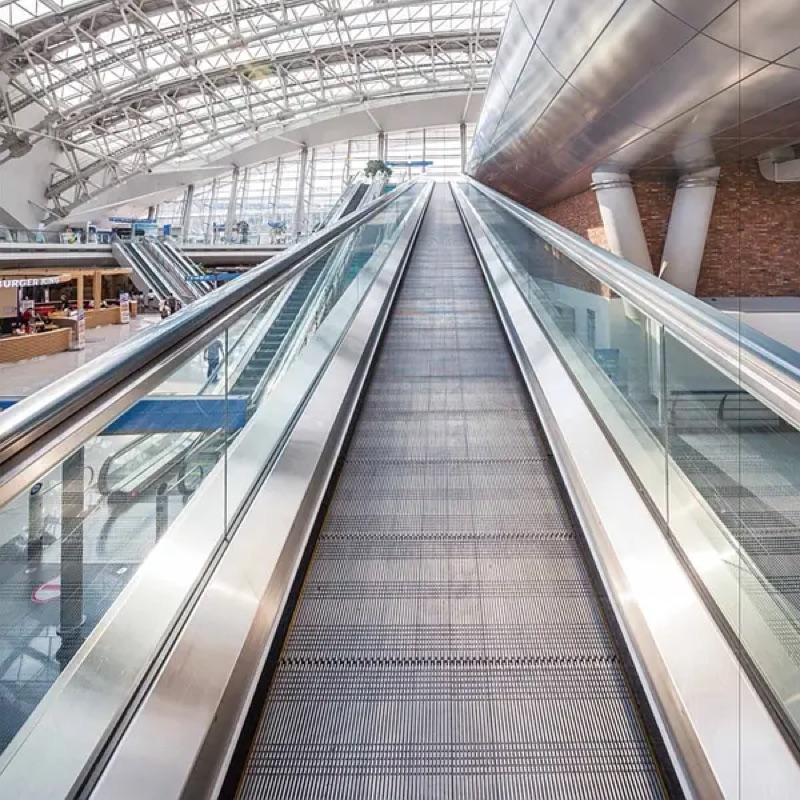
Travelator
A travelator carries people and goods not between floors but over a distance on one level: from a shopping centre entrance to the halls, from the ticket desks to the platform, from one end of an airport terminal to the other. It can be inclined up to 12 degrees, so it also handles a small difference in height.
There are no steps, just a continuous belt, so a pushchair, a suitcase or a shopping trolley rides on easily. Nobody has to lift anything or wait as they would for a lift: the walk moves continuously.
- Where they are installed: shopping and leisure centres, airports, stations, hospitals, sanatoriums.
- Components: truss, traction chain, drive, balustrades, handrails and the moving belt itself.
- Optional: automatic handrail cleaning for high-traffic locations.
- The power supply is the same as for an escalator: 380 V, 50 Hz.
- Motor power 4.3–11 kW, depending on length and inclination.
When to choose
How a travelator differs in practice
An escalator is needed when people have to get to another floor. A travelator solves a different problem: a long distance on one level. Four differences you notice in everyday use.
Trolleys, suitcases, long and bulky items. They don't stand on steps, but they do on a flat belt.
That is why a travelator is considered safer than an escalator, and with heavy traffic it shows.
In a power cut people simply walk along it. An escalator's steps, in that case, become stairs.
In Lithuania an automatic monitoring system is mandatory for a lift, but not for a moving walk. Electricity consumption is lower too.
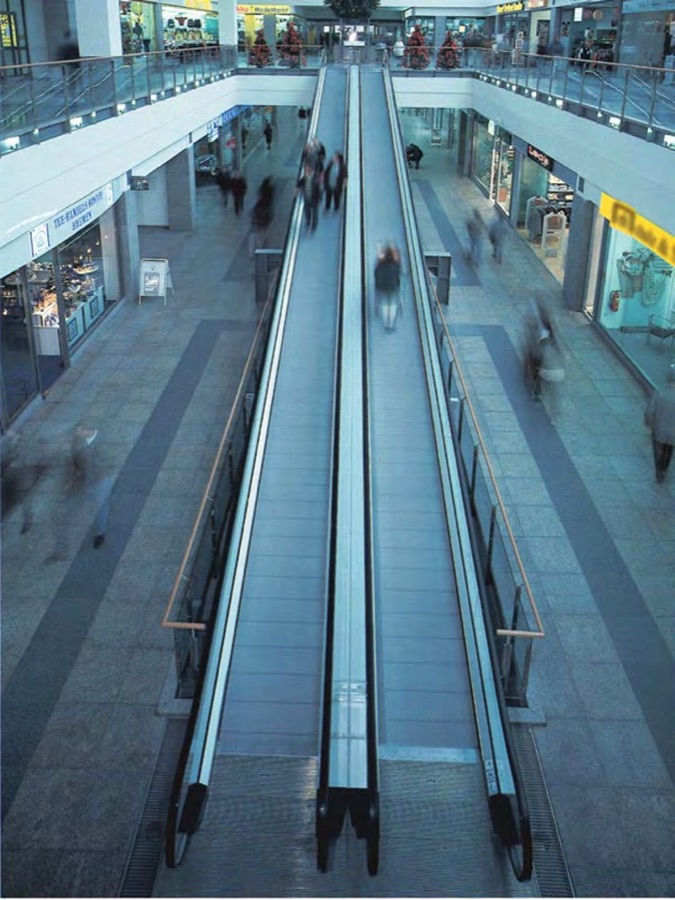
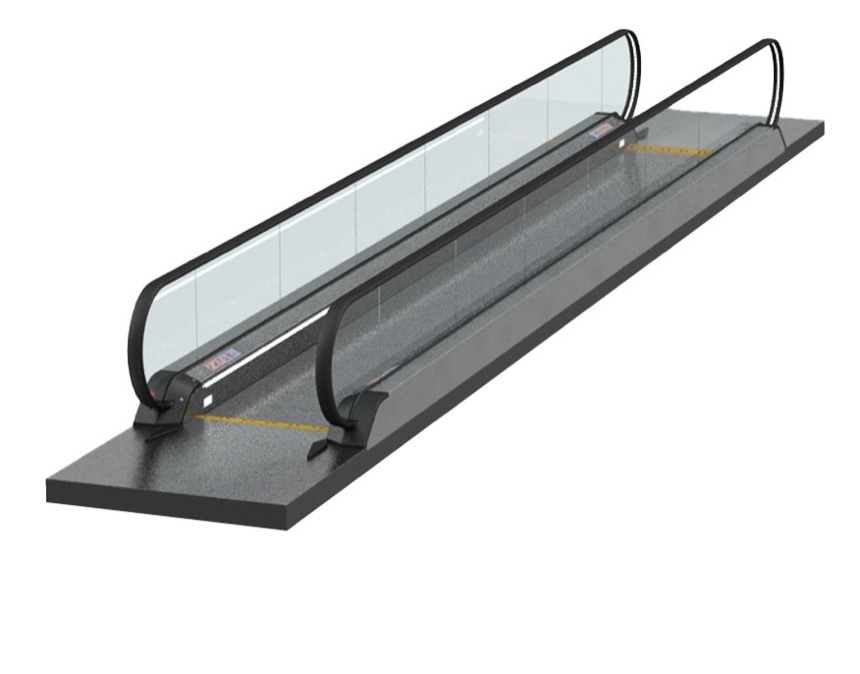
The length and inclination of a travelator are calculated for each site, so exact dimensions are agreed during the inspection.
Finish
Balustrade series
Three series, each with or without a frequency inverter. The inverter is marked by the letter F at the end of the name, and it is what lets the escalator slow down when nobody is on it.
| Balustrade series | Inner side panel | Balustrade colour |
|---|---|---|
| KP-B / KP-BF | Stainless steel | Black |
| KS-SB / KS-SBF | Clear tempered glass | Blue |
| KS-LB / KS-LBF | Clear tempered glass | Red with white LED lighting |
The exterior finish, seam direction and LED lighting at the base of the balustrade are matched to the interior.
Safety
What stops the escalator
Most of these devices are standard equipment that meets international safety requirements.
| Function | What it does |
|---|---|
| Phase loss protection | If a supply phase is lost or the phase sequence changes, the escalator stops automatically. |
| Reversal protection | If it starts moving in the opposite direction, the motor is cut off and the brake engages. |
| Comb plate and step chain monitoring | If an obstruction or a chain fault is detected, the escalator stops. |
| Skirt deflector and handrail speed monitoring | Prevents entrapment between the skirt panel and the steps, and checks that speeds match. |
| Emergency stop button | Lets the escalator be stopped by hand. |
Control
Energy saving and monitoring
| Function | What it does |
|---|---|
| Passenger flow detection | When there are no passengers, the escalator switches to slow or standby mode and saves energy. |
| Remote monitoring system | Its status is visible on a computer, and it can be switched on and off remotely. |
| Voice announcements and alarms | Gives voice announcements and stops automatically on a signal from the fire alarm system. |
| LED lighting | Lighting of balustrades, side panels and steps, improving safety in darker spaces. |
Escalator or travelator?
The answer depends on the height difference and whether people will travel with trolleys. Tell us about your site and we will propose the right option with dimensions.
Request a quote